Reusable operating playbooks for complex delivery programs
Execution blueprints for migration, incident response, and data quality programs that require repeatability across teams and environments.
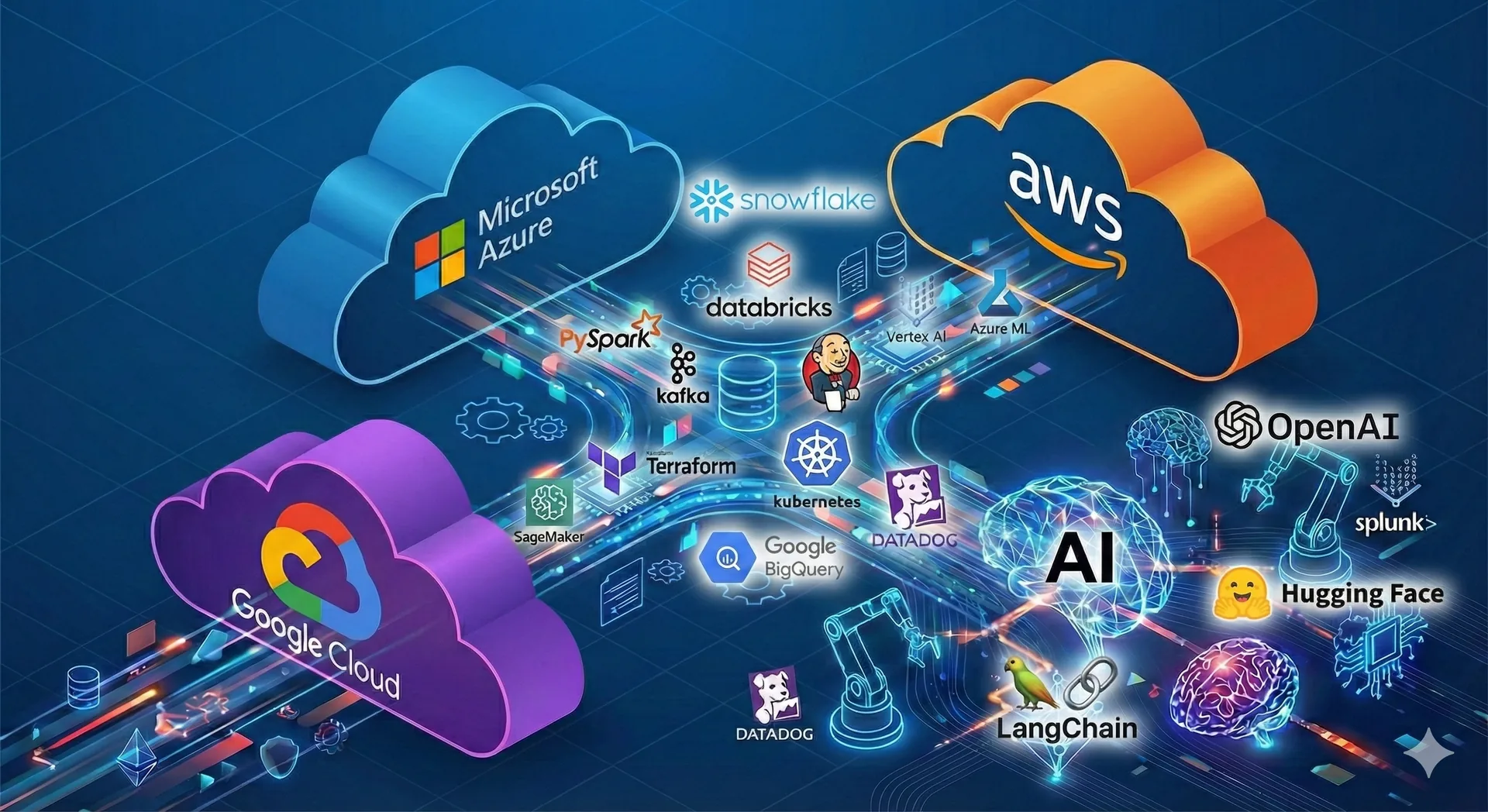
Documented execution patterns for predictable cloud, platform, and data outcomes.
Each playbook below is a reusable operating model derived from production delivery practices across multi-cloud, DevOps, and data engineering programs.
Reusable runbook for on-prem to cloud and cloud-to-cloud migration waves with controlled cutovers and hypercare.
When This Starts
- Portfolio includes legacy data platforms, ETL jobs, or analytics stacks needing modernization.
- A migration wave requires a clear rollback, cutover control, and cross-team dependency map.
- Landing zone standards must be applied consistently across AWS, Azure, and GCP.
Execution Blueprint
- 1Discovery and dependency mapping to define migration waves and risk levels.
- 2Landing zone and environment baseline setup with IAM/RBAC, network controls, and policy guardrails.
- 3Wave rehearsal, controlled cutover, and production validation with a rollback path.
- 4Hypercare period with defect triage, reliability checks, and stakeholder reporting.
Artifacts And Outputs
- • Migration wave plan and cutover checklist
- • Landing zone baseline template
- • Rollback and hypercare runbook
Signals To Watch
- • Zero critical data-loss incidents during migration windows
- • Controlled wave execution against planned cutover windows
- • Stable post-migration platform behavior in hypercare
Delivery practice notes
- • Owned 12+ migration waves from on-prem (Oracle, SQL Server, Hadoop, legacy ETL) to AWS/Azure/GCP, migrating 200+ TB and 1,000+ production jobs with controlled cutovers.
- • Led cloud-to-cloud replatforming programs (AWS to Azure, AWS to GCP, and Azure to AWS) for analytics and DevOps stacks, with zero critical data-loss incidents during migration windows.
- • Automated landing zones and environment provisioning with Terraform and GitLab CI/CD for VPC/VNet, EKS/AKS/GKE, IAM/RBAC, networking, and policy baselines.
Structured response model for reliability incidents with runbook-driven triage, SLO-aware alerting, and fast recovery.
When This Starts
- SLO/SLA breach risk is detected through observability alerts.
- Build, deployment, or runtime failures affect production paths.
- On-call teams need a repeatable triage and escalation flow.
Execution Blueprint
- 1Classify incident severity and establish an incident command channel.
- 2Run diagnostics against observability signals to isolate blast radius.
- 3Apply mitigation or rollback path and validate service stabilization.
- 4Close with post-incident actions, ownership, and preventive controls.
Artifacts And Outputs
- • Severity matrix and escalation tree
- • Incident triage and rollback runbook
- • Post-incident action register
Signals To Watch
- • MTTR trending toward under 20 minutes for high-priority cases
- • Sustained high platform uptime with proactive remediation
- • Lower repeat-incident rate through runbook automation
Delivery practice notes
- • Maintained 99.99% uptime using Prometheus, Azure Monitor, Grafana, and SLO/SLA dashboards with proactive remediation automation.
- • Drove MTTR improvements from 2 hours to under 20 minutes by addressing build failures, resource contention, and deployment bottlenecks.
- • Implemented full-stack observability (Prometheus, Grafana, Datadog, Splunk) with actionable alerting and runbook automation.
DataOps-first quality rollout for critical pipelines using automated checks, contracts, and SLA tracking.
When This Starts
- Critical reporting or AI features depend on trusted data quality.
- Pipeline changes require contract tests before promotion.
- Reliability and accuracy SLAs need measurable enforcement.
Execution Blueprint
- 1Define business-critical datasets and quality rules with ownership.
- 2Implement automated validation gates in pipeline release workflows.
- 3Enforce contract tests and monitor drift on curated data products.
- 4Run SLA reviews and close gaps with DataOps remediation cycles.
Artifacts And Outputs
- • Dataset quality policy catalog
- • Automated validation and contract test suite
- • Data quality SLA dashboard
Signals To Watch
- • Sustained data accuracy SLA performance
- • Reduction in production incidents tied to pipeline defects
- • Predictable release quality through DataOps checks
Delivery practice notes
- • Implemented data quality gates with Great Expectations and custom PySpark checks, maintaining 99.9% data accuracy SLAs across business-critical datasets.
- • Introduced DataOps engineering practices (unit/integration/E2E tests, contract tests, release templates), improving pipeline reliability and reducing production incidents by 55%.
- • Implemented orchestration standards across MWAA (Airflow), Azure Data Factory, and Cloud Composer, governing 100+ DAGs/pipelines with SLA-aware alerting.
Need a tailored execution plan?
These playbooks can be adapted to portfolio shape, compliance constraints, and delivery team topology.